
By: Nathalie Beghin, member of the Coordinating Council of Red de Justicia Fiscal de América Latina y el Caribe and a member of the board of directors of INESC
Originally published by Red de Justicia Fiscal de América Latina y el Caribe here.
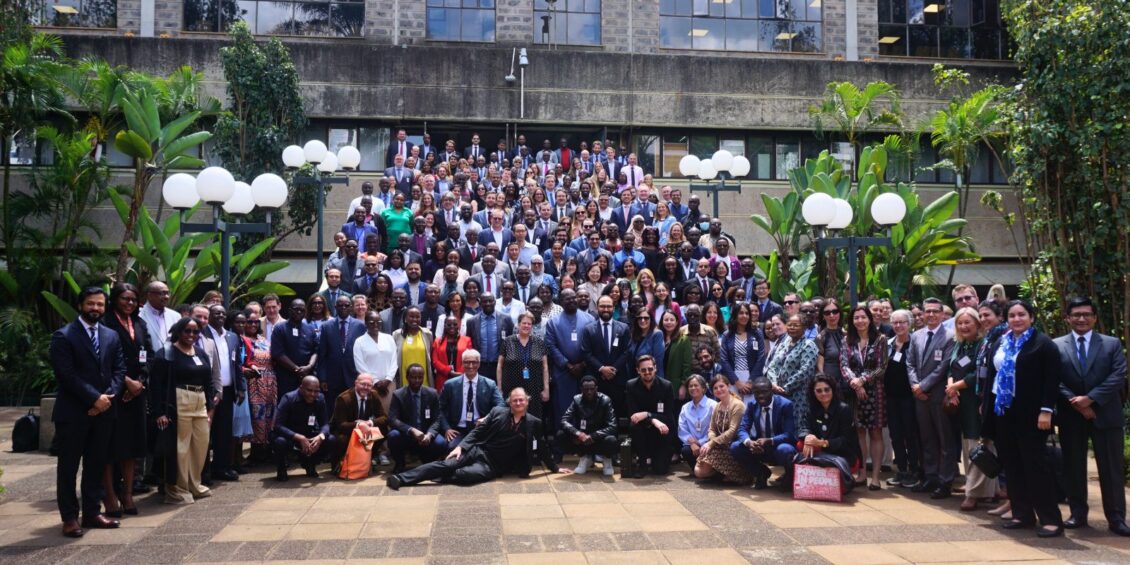
The third session of negotiations for the UN Framework Convention on International Tax Cooperation (UN Tax Convention), held in Nairobi from November 10 to 19, 2025, marked a turning point. International tax cooperation, historically remained confined to exclusive, technical platforms, are being discussed for the first time in a truly multilateral setting, with much more articulated, visible, and politically asserted positions from the Global South.
Nairobi made it clear that the international tax system can no longer be sustained on its current broken foundations. The tensions and agreements in the discussions revealed that we are facing a profound debate about how to finance development.
Context and mandate of the Convention
In 2024, the UN General Assembly approved the creation of an Intergovernmental Negotiating Committee (INC) with the mandate to draft a Framework Convention on International Tax Cooperation, accompanied by two early protocols. This process, long demanded by developing countries and civil society organizations, aims to build an inclusive, modern, and fair international tax system capable of addressing the digitalization of the economy, the growing power of multinational corporations, cross-border illicit financial flows, and tax evasion and avoidance.
After two initial rounds of negotiations in New York in August, Nairobi brought together Member States, international organizations, civil society, academia and the private sector, organized into three parallel workstreams: the drafting of the core text of the Convention (Workstream I); the early protocol on taxation of cross-border services in a digitized economy (Workstream II); and the protocol relating to the prevention and settlement of tax disputes (Workstream III).
In this third session, the debates ceased to be merely technical and became political discussions about the redistribution of tax power.
Central themes and key debates
During the session, several particularly relevant points of discussion emerged from discussions on a draft text:
- Fair allocation of taxing rights
Perhaps the most fundamental debate is on a fair allocation of taxing rights. The draft of Article 4 presented in Nairobi stipulates that any jurisdiction where a taxpayer conducts economic activities—whether where value is created, where the market is located, or where income is generated—should have the right to tax that income. This approach seeks to counter what many governments in the Global South have denounced as a biased global tax order that favors jurisdictions with favorable treaties, low-tax regimes, or “tax havens.”
- Taxation of high-net-worth individuals (HNWIs)
Article 5—dedicated to “High-Net-Worth Individuals”—sparked intense debate. Measures were proposed to expand the schemes for exchanging information on assets, income, and transactions, in order to prevent tax evasion and avoidance.
- Mutual administrative assistance, illicit financial flows and harmful tax practices
The draft Convention includes Article 6 on “mutual administrative assistance,” which aims to ensure that States cooperate in the exchange of information, transparency, country-by-country reporting, mechanisms to combat tax avoidance, evasion, and illicit financial flows. The debate in Nairobi revealed tensions: some countries advocate for a broad definition of “harmful tax practices,” calling for more ambitious approaches; others warn of duplication with existing initiatives (for example, the OECD) and requested criteria to hinder legitimate cooperation.
- Cross-border tax dispute resolution
Another key issue—addressed by Workstream III—is how to prevent and resolve jurisdictional disputes when multiple states claim the right to tax the same revenues, or when disputes arise over the interpretation of regulations. Discussions included the possibility of binding instruments, arbitration procedures, advance pricing agreements, and multilateral mechanisms to ensure greater equity. This is a sensitive point because many countries in the Global South currently lack the capacity and experience in international arbitration—in a international tax system which structurally disadvantages them.
- Principles of sustainability and development
The session also addressed—albeit in a preliminary way—the links between international taxation, tax justice, and sustainable development. The approach seeks to strengthen national revenue collection as a key tool for financing the progressive realization of human rights, infrastructure, care and reparations policies, and the achievement of the Sustainable Development Goals (SDGs).
Several countries and civil society organizations stressed that this Convention can change the rules of the game: moving from a logic of aggressive tax planning (with low rates, preferential regimes, etc.) to one of responsibility, equity, transparency and redistribution.
Tensions, challenges, and points of friction
Despite the political momentum generated by this process, Nairobi also revealed deep tensions:
- Differences between Global South and Global North countries, especially regarding capital mobility and tax sovereignty.
- Unequal administrative and technical capabilities, which could worsen if tailored technical assistance is not guaranteed.
- Attempts to reduce the mandate of the Convention, under the argument of avoiding duplication with existing regimes.
- Fragmentation of the debate due to three simultaneous workstreams, which disadvantages countries with small delegations and scatters key discussions before agreements are finalized in the main text.
These tensions not only highlight the technical challenges, but above all the political disputes over the international tax system.
Global significance and historic opportunity
The historical importance of this process cannot be underestimated. The Convention is not simply about “negotiating tax rules,” but about fundamentally rethinking a global tax system that can finance sustainable development, protect countries’ tax sovereignty, and reduce inequalities between countries.
In a context of declining international aid, delays in development financing, and growing social, climate, and infrastructure demands, expanding domestic revenue collection is crucial. The Convention could provide developing countries with tools to capture revenue shifted to tax havens and combat erosive practices that affect their tax base.
Nairobi demonstrated that this transformation is possible and that there is political will—albeit uneven—to move towards a fairer, more inclusive, and more transparent global tax system.
The session in Nairobi did not resolve the tensions, but it did make them explicit and set the stage for the 2026 and 2027 negotiations. Future discussions will have to decide whether we will have a robust Convention, with a strong core text operationalized through a Conference of the Parties, or a fragmented instrument that reproduces the limitations of the current system.
The turning point has been reached: since Nairobi, no one can claim that the international tax system works. What is decided from 2026 onward will be crucial in closing—or widening—global economic gaps, ensuring that corporations and high-income individuals pay their fair share, and guaranteeing that countries have the resources to finance human rights, social welfare, the climate transition, and the Sustainable Development Goals.
And that is why we will continue to push: because what is at stake is not just a treaty, but the possibility of building an international tax system that, finally, reflects principles of fairness, transparency and justice.