
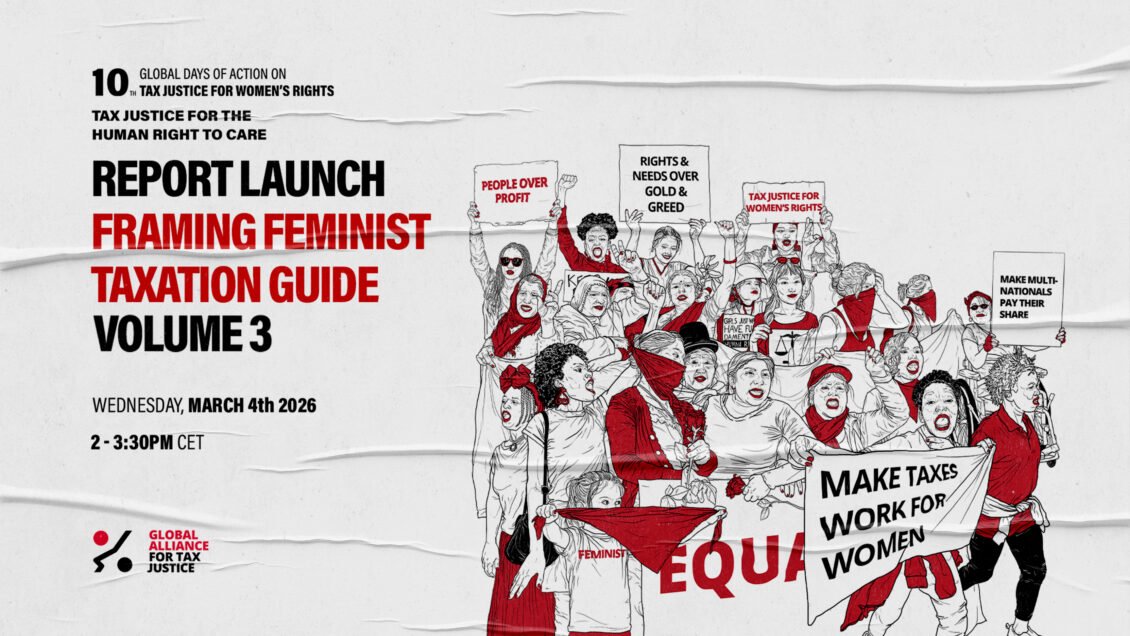
Highlights from the launch of the third publication connecting tax policy, gender equality, and care systems with case studies from Argentina, Ecuador, Paraguay, the Philippines and Senegal.
The Global Alliance for Tax Justice (GATJ)’s Tax and Gender Working Group with the support of NAWI AfriFem Collective launched the Framing Feminist Taxation Volume 3 during the 10th Global Days of Action on Tax Justice for Women’s Rights. To commemorate the release of the guide, partners came together for a webinar to present key findings from the report. Crystal Simeoni (NAWI AfriFem Collective) highlighted the importance of this research, sharing that“fiscal policy is a deeply political choice about what and whom we value.”
Connecting Tax Policy to Gender Equality and Care Systems
Taxation and care are deeply interrelated. Taxes can be used to finance the public services that make life possible: public health and education; long-term care for people with disabilities and the elderly; maternity and paternity leave; minimum incomes for those who need them most; and the construction of drinking water systems and basic essential infrastructure. Noelia Mendez Santolaria (DAWN Feminist) emphasised the issue: “when we look at how taxes are designed, we see that the world’s tax systems are failing those of us who live from our work, women and gender-diverse people, and especially those of us who live in the Global South.”
At the same time, a tiny minority of ultra-rich men—and large financial and extractive corporations–take advantage of broken global tax rules to avoid and evade taxation while continuing to hoard their wealth, to the detriment of us all. States are then left without the necessary resources to guarantee basic rights from health to care. Mendez Santolaria expanded upon the issue “When the State withdraws, care must continue and even increases because someone has to sustain life. And that someone, almost always, is a woman.”
The latest volume includes case studies from Argentina, Ecuador, Paraguay, the Philippines and Senegal. The authors of the publication shared highlights from their studies:
Argentina
Regarding Argentina, Mendez Santolaria explained that “for the last few decades, the country has been a true laboratory for neoliberal policies.” Using the classic recipe of lowering taxes for the rich, deregulation, and dismantling the State apparatus, neoliberal governments promise investment and social prosperity while delivering the exact opposite. Argentina’s tax system relies significantly on indirect taxes like consumption taxes, meaning that low-income populations carry a disproportionate tax burden. Due to high levels of debt, Argentina also uses a large portion of State resources to pay back loans rather than sufficiently funding education, health, and social protection. According to Mendez Santolaria, “Financing care is not just a technical discussion. It is a political debate about what kind of society we want. As for us, we want to construct a society that takes care of the 99%, not one that creates sacrifice zones for the 1%.”
Ecuador
In Ecuador, it is clear that there is no sustainable policy about care without implementing structural tax reforms. The fulfillment of human rights, from education to care, require sufficient tax revenues. Under the current tax system, regressive taxes deepen inequalities and prevent a sustainable care system. Klelia Guerrero Garcia (Latindadd) shared the need for action: “This system, built upon regressive taxation and allowing for rampant tax abuse, is the result of political decisions. There is hope: because it is the result of a political decision, this system can be changed.” Instead, Ecuador must implement progressive taxes to ensure that those with the most pay their share. Guerrero Garcia also highlighted the need for reform in the global tax rules so that countries can tax the activities that take place in their borders.
Paraguay
Paraguay has very few care policies, and those that exist often benefit only the most privileged sectors of the population. Social protection policies, like those meant to provide legal protections for domestic workers, are often simply not implemented. In terms of financing, the tax system is characterized by low revenues, regressive taxes that place an undue burden on those least able to pay, tax breaks for the rich, and high levels of tax evasion and tax abuse. In addition, debt burdens further restrain the fiscal space. Veronica Serafini (Latindadd) reminds us that “what we spend on care is an investment, not an expenditure.”
The Philippines
The Philippines has placed a lot of effort into promoting equality through social protection programs, including a successful conditional cash transfer program that covers two thirds of the poor population, well above global averages. The Philippines exports a large amount of care work to the rest of the world. According to Riva Jalipa (Amnesty International), “This phenomenon of overseas foreign workers presents a Catch-22 situation because you are promoting vulnerability but it provides revenue for the country. 10% of GDP comes from domestic remittances, but it breaks the social fabric.” Overall, Japlipa shared that the Philippines is making important strides in care policies, but could benefit from a national care policy to reduce fragmentation as well as reformed global tax rules.
Senegal
In the case of Senegal, the case study focuses on women employed in the informal sector, which represents 92% of working women. Senegal heavily relies upon indirect taxes, this regressive tax structure means that those who have less are forced to contribute more. As Marieme Gnagna Thiam (International Budget Partnership) so eloquently proclaimed, “Women are not being taken into account in tax policy. Despite significantly contributing to tax revenues, women do not get the benefits. Tax therefore can and must become a tool for social justice. Women are not asking for favors, women are only asking to know how their taxes are being used.”
The case study authors also shared the key recommendations for governments and policymakers from Framing Feminist Taxation Volume 3:
- Explicitly define and mainstream care in fiscal policy frameworks, national development plans, and budget classifications.
- Integrate care into tax reform processes—design tax systems that recognise and redistribute unpaid care work, such as through credits, exemptions, or direct transfers targeted at care providers.
- Allocate sustained, equitable public financing to public care services, including early childhood education, elder care, healthcare, disability services, and support for unpaid caregivers.
- Simplify and harmonise care policies across sectors framed in the recognition of care as a human right to build coherent, rights-based, and universal care systems rather than piecemeal programs.
- Establish care data systems that measure unpaid and paid care work, financing gaps, and intersecting inequalities across gender, income, race, and geography.
Learn more and read the Framing Feminist Taxation Guide Volume 3 here in English, Spanish, and French.