
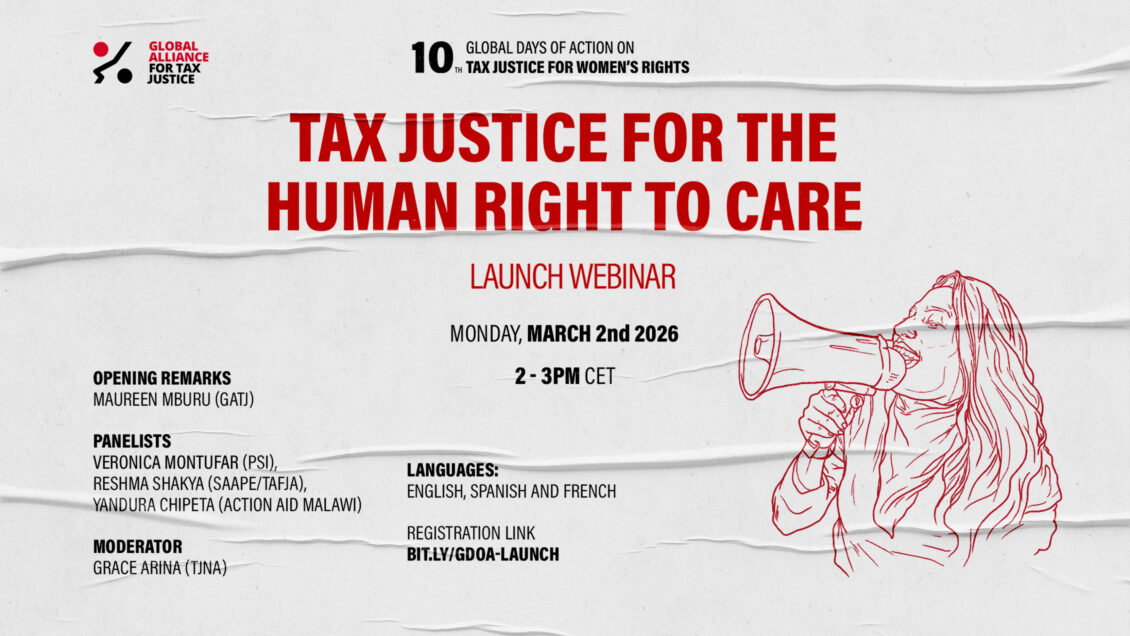
Feminists, trade unionists, and tax justice advocates launched the campaign to demand Tax Justice for the Human Right to Care on March 2, 2026.
Feminists, trade unionists, and tax justice advocates stand together to demand “Tax Justice for the Human Right to Care!” The call takes place under the 10th Global Days of Action on Tax Justice for Women’s Rights.
As the Coordinator of the 2026 Global Days of Action, Maureen Mburu, from the Global Alliance for Tax Justice (GATJ) highlighted the connection between care and taxation:“Recognising care as a human right requires a shift in how we design our economies. It means ensuring universal access to quality, affordable care services, decent working conditions for care workers, and strong public systems that reduce and redistribute the unequal burden of care carried by women. Achieving this depends on a fundamental factor: adequate and sustainable public financing.”
Care as a Human Right
The call for “Tax Justice for the Human Right to Care” builds upon years of work by policymakers, feminists, and trade unionists. In 2021, a group of civil society and trade unions released the Care Manifesto: Rebuilding the social organisation of care which highlights the 5 R’s of care:
- Recognizing the value of care work,
- Rewarding, remunerating, and representing care workers,
- Reducing the burden of unpaid care work on women,
- Redistributing care work for a more equal distribution,
- and Reclaiming the public nature of care services.
Veronica Montúfar, from Public Services International (PSI) and member of Red de Justicia Fiscal de América Latina y el Caribe (RJFALC), emphasised the responsibility of the State to perform its fundamental role to provide, finance, and regulate care systems centered around people, not profits. She pointed to the Inter-American Court of Human Rights’ recognition of care as an autonomous human right. Montúfar affirmed: “we need public investment in public care.”
Developing Global Tax Rules for Gender Equality and Care
“Tax systems are not just technical tools, but they are also political and economic choices that influence who pays for public services and, consequently, who benefits from them,” asserted Reshma Shakya, from South Asia Alliance for Poverty Eradication (SAAPE) and Tax and Fiscal Justice Asia (TAFJA).
At present, the global tax rules do not work for people or the planet. The unequal distribution of taxing rights embedded in the international system and ineffective tax rules results in multinationals corporations and high net-worth individuals taking away billions of dollars in tax revenue, particularly extracted from Global South countries. With less public funding for essential public services, women and girls are forced to fill in the gaps with unpaid care work. Civil society, including human rights movements, feminists, grassroots movements, and community networks play a crucial role in advocating for fair and effective global tax rules through the ongoing historic negotiations for a UN Framework Convention on International Tax Cooperation (UN Tax Convention). The negotiations run until mid-2027 and are set to produce a Framework Convention and two early protocols.
Yandura Chipeta, from ActionAid Malawi, stressed the importance of the negotiations:“We need to advocate for fair global tax rules through a UN Tax Convention that embeds gender equality in all its dimensions.” The current tax rules favor source-based taxation, which limits Global South governments from collecting taxes from multinational corporations who are often headquartered in the Global North. In Africa, and Malawi specifically, Chipeta explained how the fiscal space is further constrained by debt and IMP imposed austerity policies.
The 2026 campaign includes the demands for governments to formulate a legally-binding UN Tax Convention that includes gender equality in all its provisions and ensures the fair distribution of taxing rights, enabling governments to finance quality public services that fulfill the human right to care.
Uniting to Make Taxes Work for Women
These Global Days of Action represent a crucial moment to come together and demand change. Grace Arina, from Tax Justice Network Africa (TJNA), emphasised this:“Change is possible when movements, advocates, and policymakers unite across regions, and we have a crucial opportunity in the UN Tax Convention negotiations to come together and transform our tax systems to center people and the human right to care.”
Our governments must center care as a human right and formulate a legally-binding UN Tax Convention that includes gender equality in all its provisions and ensures the fair distribution of taxing rights, enabling governments to finance quality public services that fulfill the human right to care.
The campaign has a clear message: there can be no gender equality without strong public care systems, and no strong public care systems without fair and effective taxation.
- Take part in the events and see the full programme here.
- To receive the campaign toolkit, send an email to [email protected].