
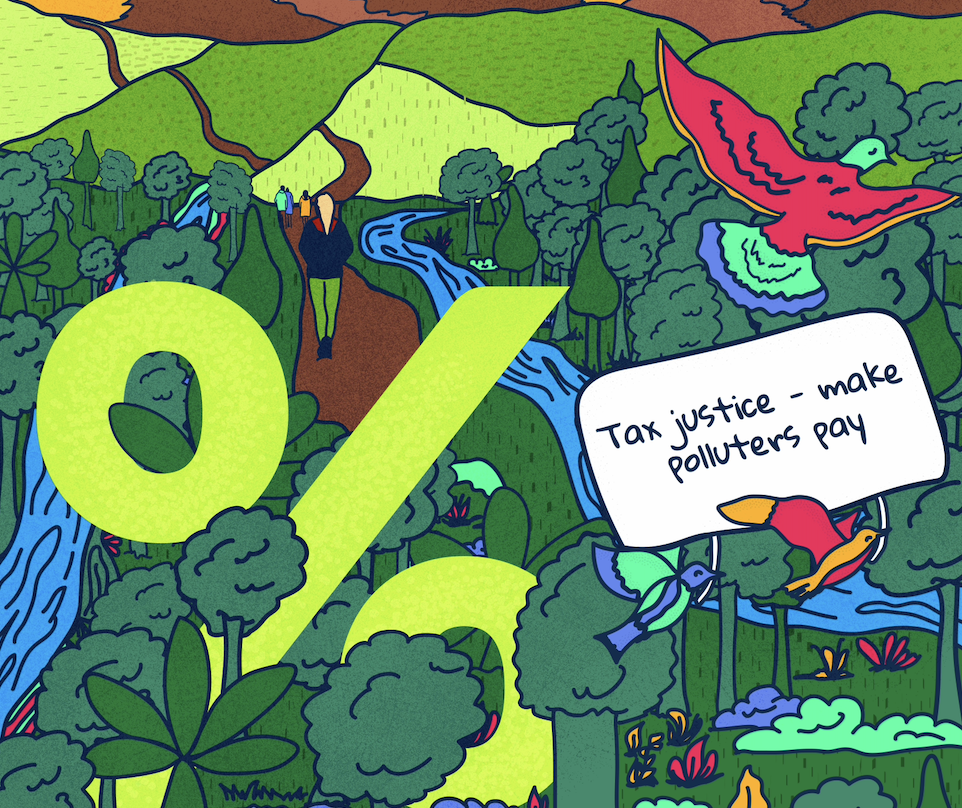
A new report shows that more than a trillion dollars could have been raised for climate action and development since the adoption of the Paris Agreement in 2015, if the world’s 100 largest oil and gas companies had been charged a 20 per cent surtax on their enormous profits.
New research shows that more than a trillion dollars could have been raised for climate action and development since the adoption of the Paris Agreement in 2015, if the world’s 100 largest oil and gas companies had been charged a 20 per cent surtax on their enormous profits.
The report illustrates that if a surtax had been applied in the fiscal years 2022, 2023 and 2024 it would have generated an estimated US$236 billion, US$184 billion and US$147 billion respectively.
Make polluters pay: Proposal for a surtax on fossil fuel industries’ profits has been produced by the Global Alliance for Tax Justice (GATJ) and the European Network on Debt and Development (Eurodad). The surtax it proposes represents a decisive step toward phasing out fossil fuels, redirecting industry away from polluting activities, and promoting a new paradigm in environmental taxation.
The release of this report comes at the start of the UN Tax Convention negotiations in mid-November in Nairobi, Kenya, in parallel to the COP 30 climate negotiations in Belém, Brazil. In relation to the future UN Tax Convention, civil society groups are urging governments to include a Polluter Pays surtax on fossil fuel companies.
The author of the report, Markus Trilling, Senior Policy and Advocacy Officer, Progressive Green Taxation at Eurodad said: “The fossil fuel industries have long filled their pockets at the expense of a safe and stable climate. A surtax on fossil fuel profits – which reached a record US$4 trillion in 2022 – would place the responsibility of financing a just transition at the feet of those most responsible – the polluters themselves.
“It is time to hold polluting capital accountable: hundreds of billions are needed for climate action. The surtax on fossil fuel profits can provide for life-saving public revenues and shift capital away from fossil fuels over time. Climate negotiators at COP 30 and tax negotiators in Nairobi must unite to make the fossil fuel profits surtax happen.”
Dr. Dereje Alemayehu, Executive Coordinator of GATJ said: “Fossil fuel companies are making obscene profits — in the billions — at the expense of a livable planet, at the expense of us all, while driving us faster toward climate catastrophe. As if that weren’t bad enough, they receive trillions in subsidies every year from governments.
“This paper presents a powerful tool to change course: taxation. Implementing the Polluter Pays Surtax can equip countries with the billions needed to enable a just transition — toward a world where all workers, and all people, can live in a sustainable environment, without fear and in dignity.”
Adrián Falco, Coordinator of Red de Justicia Fiscal de América Latina y el Caribe, commented: “The COP30 climate negotiations in Belem will discuss the desperate lack of climate finance. But this report shows that there is no lack of finance. Climate negotiators should send clear messages over the ocean to their colleagues simultaneously negotiating the UN Tax Convention in Nairobi: there are hundreds of billions hidden in tax havens and lost through tax dodging by multinationals and the ultra rich. It is time that these resources are used to benefit the public from funding climate-resilient infrastructure to quality healthcare.”
Fossil fuel profits have continued to grow in recent years, with profits skyrocketing to a record high in 2022 at US$ 4 trillion. At the same time, data suggests that these profits are diverted primarily to shareholders and to expanding fossil fuel production, with only minor investments directed to the clean energy transition. In a world where it pays to pollute, fossil fuel companies have little incentive to embrace the transition away from fossil fuels. A surtax on the industries’ profits could be one means for forcibly halting the continued expansion.
Chenai Mukumba, Executive Director of Tax Justice Network Africa shared: “The window of opportunity for preventing ecological breakdown is rapidly closing and so we need new approaches for addressing the worst impacts. At the same time, fossil fuel and extractive industries are bleeding billions of dollars out of the continent. This proposal for a polluter pays surtax is critical to recovering African resources.”
Jeannie Manipon, Co-Coordinator of Tax and Fiscal Justice Asia, added: “The fossil fuel industry bears a huge responsibility for the climate crisis but ordinary people, especially in the Global South, bear the heaviest social and environmental costs. In the last decade over a trillion dollars could have been collected in tax revenues alone and used to respond to the scale and urgency of the climate crisis. A global surtax on fossil fuels, increasing it till it reaches 100 percent by 2050 and using revenues to address inequalities and finance climate action, will accelerate us on a path towards just and equitable transition.”
END
Media contact
Mary Stokes, Senior Communications Officer, European Network on Debt and Development: [email protected]
Alexandra Wenzel, Global Communications Coordinator, Global Alliance for Tax Justice: [email protected]
Note to editors
- Read the report here.
- Negotiations on the UN Tax Convention are taking place in Nairobi from 10 – 19 November. More info, and link to the live webstream here.
- The Terms of Reference for a new UN Framework Convention on International Tax Cooperation and two early protocols can be found here.
- Further information about how the first two sessions went can be found here.