
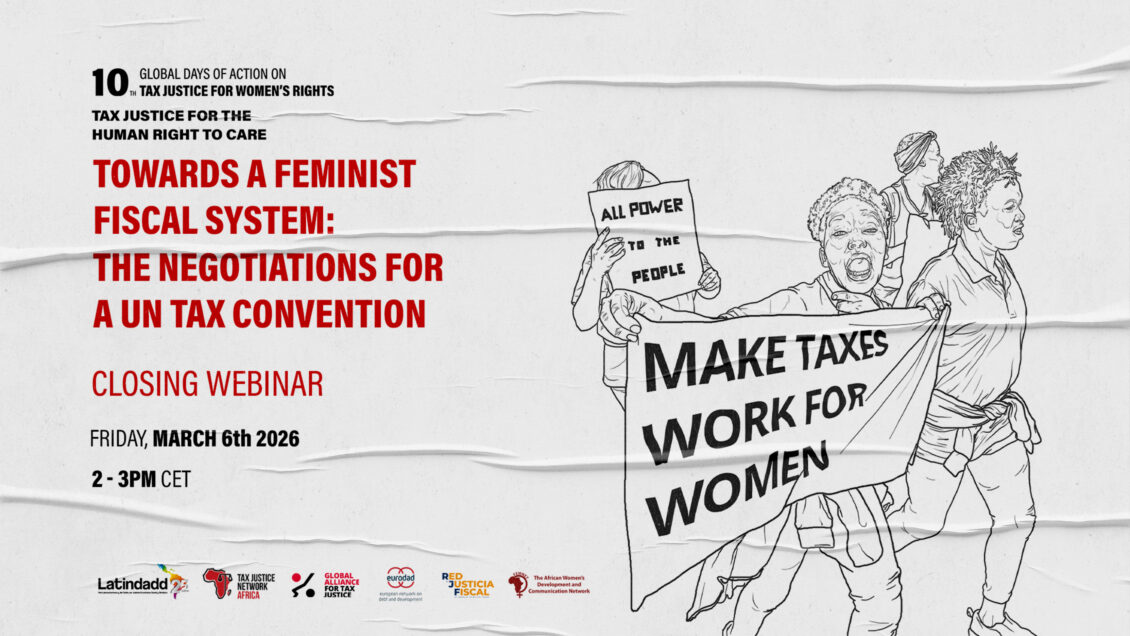
Reflections at the end of the 10th Global Days of Action on Tax Justice for Women’s Rights on the historic opportunity to reform the global tax rules.
At the end of the 10th annual Global Days of Action on Tax Justice for Women’s Rights, feminists, trade unionists, and tax justice advocates came together to discuss how to deliver a feminist fiscal system. Speakers discussed the campaign demand of “Tax Justice for the Human Right to Care” and analysed the ongoing negotiations for a UN Framework Convention on International Tax Cooperation (UN Tax Convention).
The impact of the broken international tax system on care
Women around the world perform the large majority of unpaid and underpaid care work. According to Grace Namugambe (Femnet), “when essential public services such as healthcare, childcare, water, education, and social protection are underfunded, the responsibility then shifts to households. And when it shifts to households, it primarily shifts to women to bear the brunt.”
Gender-blind tax systems fail to consider the impact that regressive taxation and austerity measures including reduced public services have on increasing inequalities and unpaid burdens on women and gender-diverse people. Investing in care systems must be at the core of fiscal policy, as evidenced in the latest publication on Framing Feminist Taxation. As Klelia Guerrero García (Latindadd) made clear, “The economy only functions because of an enormous amount of care work that allows society to function and sustains the traditional workforce. However, when States don’t have sufficient resources to finance basic public services, this care work doesn’t just disappear, it moves to the household, and primarily onto the backs of women.”
The present international tax system has a proliferation of profit shifting, tax evasion, tax abuse, and secrecy. This broken system leads to a loss of over $1 billion USD every day, limiting States from raising sufficient revenues. Ultimately, this has tremendous negative effects on gender equality.
“The social and economic costs of the deeply flawed international tax system are borne by women, especially women of the Global South, who then disproportionately bear the burden of regressive consumption taxes and contribute to the economy through unpaid care work,” explained Jeannie Manipon (Tax and Fiscal Justice Asia). To achieve development and to combat inequalities requires a fundamental restructuring of the international tax system.
Towards a feminist UN Tax Convention
From now until mid-2027, negotiations are taking place for a UN Tax Convention which is set to establish “an international tax system for sustainable development.” These negotiations have the opportunity to create legally-binding global tax rules that expand the fiscal space, supporting governments to meet their commitments on gender equality in CEDAW, the Beijing Platform for Action, and the Sustainable Development Goals. According to Tove Maria Ryding (Eurodad), the UN Tax Convention offers an opportunity to have “tax systems that support gender equality and stop tax systems that harm gender equality.”
The UN Tax Convention negotiations have a crucial mandate including: to address taxing high net-worth individuals, fairly allocate taxing rights, equitably tax multinational enterprises, address illicit financial flows, and contribute to the achievement of sustainable development.
Everlyn Muendo (Tax Justice Africa) explained how creating fair and effective global tax rules would in turn advance gender equality, “ensuring a fair allocation of taxing rights is tax justice, which is gender justice as well.” The current international financial architecture was developed a century ago, a time when most African nations didn’t yet have political independence. These tax rules are deeply flawed and work in favor of a very small group of Global North countries. The result is that governments, particularly in the Global South, are unable to properly tax multinational corporations. This often means turning to taxes that are administratively easy, like consumption taxes that have a deeply regressive effect. These regressive taxes deepen inequalities, especially deepening gender inequality. Muendo explained that we must “call for an international tax system where source countries, which are primarily Global South countries, actually have taxing rights so we can exercise our own tax sovereignty, our own development and share the tax burden more fairly.”
A historic opportunity to make taxes work for women
As feminists, as labor activists, as tax justice advocates, it is imperative that we take advantage of the historic opportunity that the UN Tax Convention presents in order to demand fair and progressive taxation that enables States to raise enough revenue to fund quality public services and fulfill the human right to care, enabling women around the world to meet their full potential. As we look to the next session of UN Tax Convention negotiations in August, we need to push our governments, our foreign affairs ministries to produce a strong and ambitious UN Tax convention.
It is time to deliver tax justice for the human right to care.