
By Lurit Yugusuk – Advocacy and Policy Officer, YTJN and Jon Kafuko – Programmes Manager, YTJN
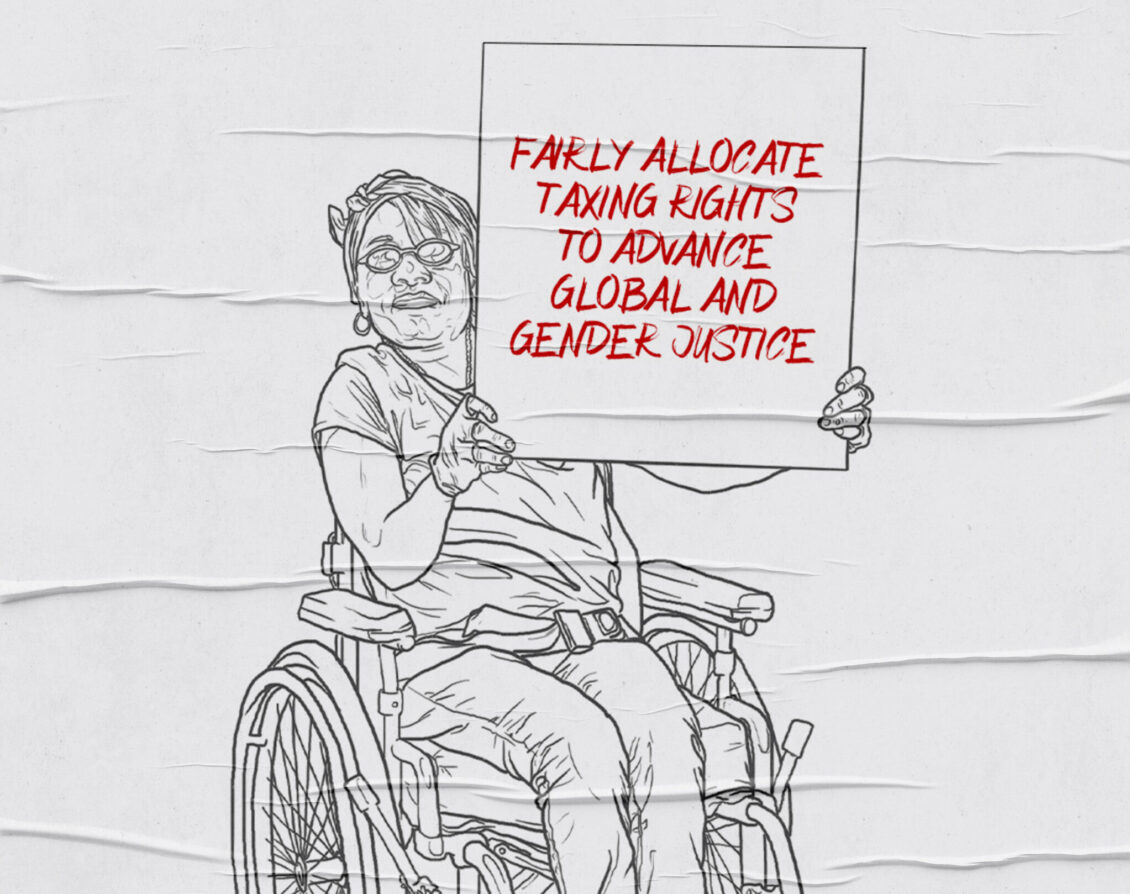
The 10th Global Days of Action on Tax Justice for Women’s Rights (GDOA) (2–8 March 2026) under the theme “Tax Justice for the Human Right to Care” calls on movements, policymakers, and communities to advance care economies. Coinciding with the International Women’s Day theme, “Rights. Equality. Empowerment. For ALL Women and Girls” this mobilization targets the structural barriers that perpetuate injustice. As we mobilize within our spaces, we are keen to reflect on a core campaign demand: Fair Allocation of Taxing Rights to Advance Global and Gender Justice.
The Care Crisis is a Fiscal Crisis deeply rooted in the structural bias of the global tax system
Care work, the invisible foundation of our world, is overwhelmingly borne by women and girls, who perform over three-quarters of unpaid care, totaling 16.4 billion hours daily and valued at an estimated US$10.8 trillion annually. A feminist analysis reminds us that this crisis is not accidental, but is instead the outcome of tax and fiscal systems that systematically undervalue social reproduction, privatize risk, and prioritize capital over people. As states disinvest in public services, women absorb the failures, stretching their time and labor to compensate.
The global tax system further exacerbates this inequity. The 2024 State of Tax Justice report reveals countries lose an estimated US$492 billion annually to tax abuse. Roughly US$347 billion of this is lost to corporate profit shifting, where multinationals book profits in low-tax jurisdictions rather than where economic activity occurs. Developing countries suffer most, as they rely heavily on corporate tax revenue.
In sub-Saharan Africa, extractive industries alone lose up to US$730 million yearly to profit shifting. A 2025 report shows Africa loses approximately US$88 billion annually to illicit financial flows and corporate tax abuse. This lost revenue could fund healthcare, education, and care infrastructure. Furthermore, Action Aid International estimates Africa loses US$29 billion annually in education finance alone, enough to put nearly 19 million girls back in school. Instead, we are told there is no money, while billions vanish into tax havens.
Meanwhile, the tax burden shifts onto the poor. In G20 countries, less than 8 cents of every tax dollar come from wealth taxes, while over 32 cents come from consumption taxes like VAT. This regressive squeeze forces governments into austerity, with women again filling the gaps through unpaid work.
These imbalances are built into international tax rules, which favour the “residence” countries of multinationals (mostly in the Global North) over the “source” countries where resources are extracted and work is done. The revenues leave the very places that bear the environmental and social costs.
How then do we reclaim fiscal sovereignty and ensure the fair allocation of taxing rights?
This is more than a debate over tax codes … It is a struggle over power: who holds it, who is denied it, and who decides the future of care. For decades, global rules have favored the wealthy North, leaving the Global South to choose between debt and investing in the people, mostly women and girls, who sustain life and livelihoods.
To reclaim fiscal sovereignty, therefore, means dismantling rules that allow a global minority to hoard resources. It means anchoring tax rights in the real economy, not in fictional paper profits. The ongoing negotiations for a UN Framework Convention on International Tax Cooperation are our chance to build an inclusive global tax architecture and rewrite these rules. Thus, we must demand;
- A convention anchored in source-based taxation, ensuring countries where economic activity occurs have the right to tax.
- A framework that recognises real economic presence over shell companies.
- A system that treats tax justice as the financial bedrock of the human right to care, funding universal healthcare, public education, and social protection.
Will the UN Tax Convention deliver justice? Over to you!