
At this moment in time, it is crucial to remind ourselves why the United Nations was created: to do everything necessary to prevent the repetition of the experiences of the Second World War.
Today, we are witnessing events and crises that should remind us of how such periods begin! That is precisely why making this conversation the point of departure matters.
Preventing a repeat of those experiences requires, first and foremost, strengthening democratic multilateralism, with the UN at its centre. When International law risks to be replaced by the rule of the jungle, the UN should be able to ensure that it is upheld and never abdicate its normsetting and norm-defending mandate.
If the foundations of an edifice are being damaged, it makes little sense to continue furnishing its individual rooms. The primary task must be to repair and reinforce those foundations. Without that, everything else becomes fragile, if not meaningless.
The Financing for Development process was conceived on the premise of a functioning system of democratic multilateralism. It cannot continue as if those original premises still hold. We cannot normalise what is clearly abnormal. Instead, we must confront the current crises directly and work to resolve them — because only then can meaningful progress be made.
The second point I want to raise is equally important. Financing for Development was never intended to be merely a fundraising instrument for the Sustainable Development Goals. It was conceived as a space to address structural governance issues and systemic imbalances in the global economic and financial architecture.
If we reduce it to a question of mobilising resources alone, we risk losing its transformative purpose.
In our statement during the Sevilla FfD conference, we translated the Spanish “Compromiso de Sevilla” as the “Sevilla Compromise.” That choice was deliberate. It reflects our concern that what is being presented as commitment, in fact, represents a lowering of ambition — a settling for less at a time when far more is required.
In conclusion, if the promising ambitions of the Financing for Development process are to be kept alive, we must return to its original purpose: addressing systemic inequities, rebuilding trust in multilateralism, and strengthening the very foundations upon which global cooperation depends.
Anything less risks reducing this to a ritual exercise—treating the symptoms while ignoring the cause.
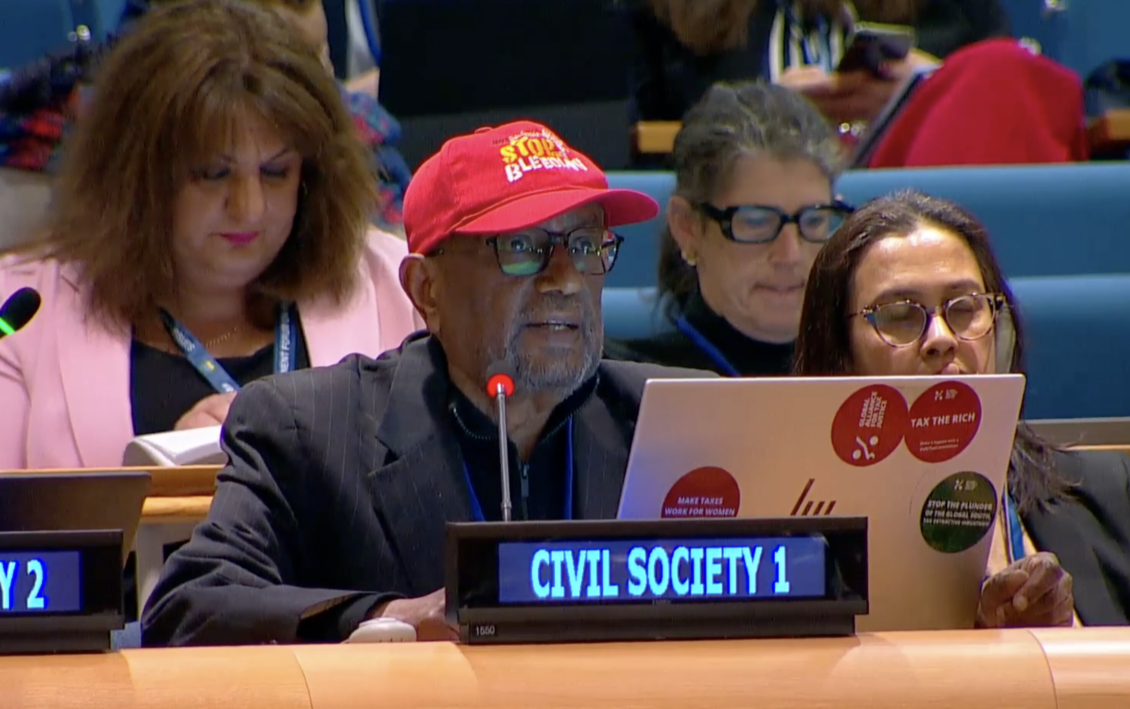
Intervention delivered by Dr. Dereje Alemayehu, Executive Coordinator of the Global Alliance for Tax Justice (GATJ) on behalf of the Civil Society Financing for Development Mechanism (CS FfD Mechanism) at the April 20, 2026, FfD Forum.
- Learn more about the FfD process on the CS FfD Mechanism website here.