
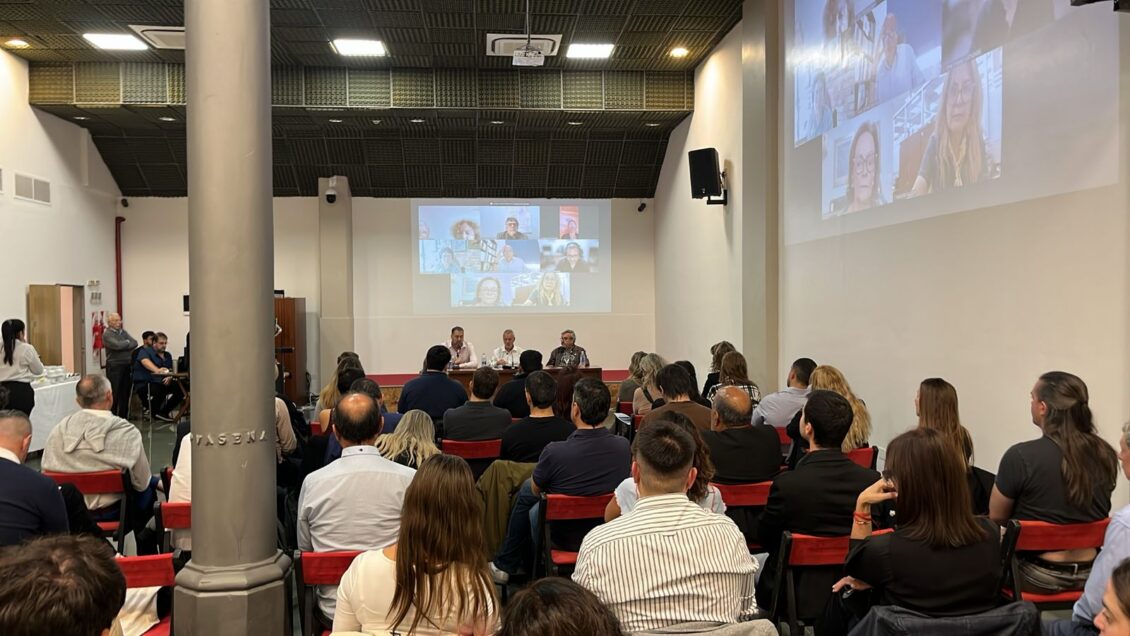
The Southern Cone Trade Union Meeting on Tax and Customs Justice was convened as a regional coordination space that brought together trade union organizations, specialists, and civil society networks to discuss the main tax and customs challenges facing Latin America and the Caribbean. The activity was promoted by Red de Justicia Fiscal de América Latina y el Caribe (RJF-LAC), Latindadd, trade unions from Argentina -AEFIP and SUPARA-, Public Services International (PSI), and the Federation of Customs and Tax Collection Officials of South America (FRASUR).
The event brought together various trade union organizations from across the region, including Sinedian from Colombia, Sindifisco Nacional from Brazil, Fentat-Sunat from Peru as well as Affich and Aneich from Chile, all of whom contributed perspectives and experiences from their respective countries.
The central focus of the meeting was the need to move toward tax systems that are more progressive, transparent, and capable of responding to the transformations of the global economy. Within this framework, key topics were addressed, including tax regressivity, taxation of the digital economy, fiscal and financial transparency, corporate tax evasion, and the strengthening of customs control and international trade oversight.
Throughout the day, participants highlighted the strategic role of unions in tax and customs administrations as key actors in the implementation of public policies, the generation of technical knowledge, and the defense of fairer fiscal systems.
The interventions coincided in pointing out that the region faces a scenario of high inequality, where tax systems still place a disproportionate burden on lower-income sectors.
Likewise, the importance of building alliances among trade unions, social organizations, and regional networks was emphasized as a way to influence public agendas and promote structural reforms — for example, by strengthening institutional capacities to confront tax evasion by large corporations and the challenges posed by the digitalization of the economy.
REGRESSIVE TAX SYSTEMS AFFECT THE REGION
Jorge Coronado, representative of RJF-LAC and member of GATJ Coordination Committee, stated that the region’s tax model is regressive and limits the State’s redistributive capacity. “The tax model in Latin America is highly regressive, sustained by consumption taxes. We must ensure that the region stops being the most unequal on the planet,” he noted. He also stressed the need to promote reforms that allow progress toward fiscal progressivity, especially through greater taxation of income and wealth, as a condition for reducing deep inequality gaps.
Adrián Falco, Executive Secretary of RJF-LAC and Coordinator of the tax justice area at Latindadd, highlighted the strategic value of working closely with trade unions: “The trade union movement is a strategic ally of Latindadd and RJF-LAC; it always has been, and on this occasion the event held in Buenos Aires is a major first step toward consolidating and building a common strategy among us, social organizations, and trade unions — not only to try to counter the rightward shift of governments in our region, but also to put forward a different agenda.“
Falco also emphasized that coordination with the trade union movement is not new, but rather part of a historic relationship that today takes on renewed relevance. In this regard, he considered that this meeting represents a key first step toward building a shared strategy among unions, social organizations, and regional networks, aimed not only at responding to the region’s political shift, but also at positioning an alternative agenda.
He also pointed out that unions in tax and customs administrations have a fundamental role to play in this process, given their potential for mobilization and advocacy, especially when they coordinate strategically with organizations such as Latindadd and the RJF-LAC.