
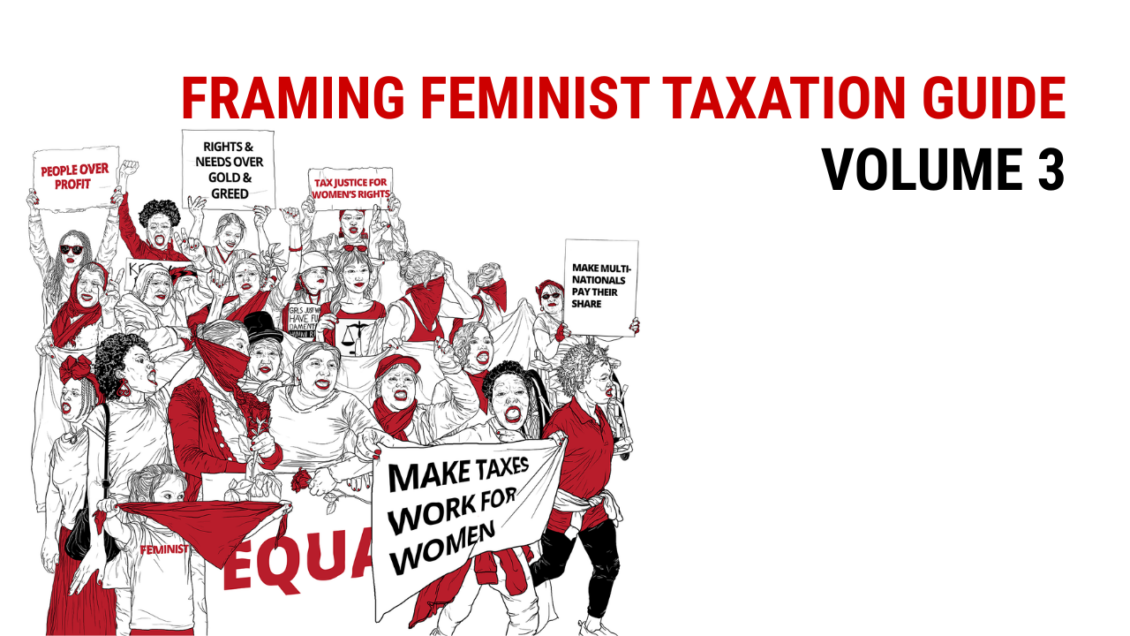
A new publication by tax policy and women’s rights experts outlines the impact of fiscal policies on care systems and gender equality looking at case studies in the Global South.
Nairobi, March 4, 2026 – At the intersection of gender equality and tax policy, the Global Alliance for Tax Justice’s Tax and Gender Working Group, including members Green Tax Youth Africa, Red de Justicia Fiscal de America Latina y el Caribe, DAWN Feminist, Latindadd, Christain Aid, IWRAW, and Tax Justice Network Africa, with the support of NAWI Afrifem Collective have released the 3rd Volume of the Framing Feminist Taxation Guide. Presenting a feminist intersectional and human rights-based approach to tax policy, the guide includes case studies from Argentina, Ecuador, Paraguay, the Philippines and Senegal. It analyses the gender bias in the current tax system and how to advocate towards a feminist tax framework – a tax system that upholds human rights and enables substantive gender equality.
The publication shows how women and girls are disproportionately hurt by current tax systems and global tax rules. Even though challenges may differ from country to country, everywhere women tend to proportionately pay more taxes and benefit less from them, as gender-biased and regressive tax systems continue to deepen gender inequality.
One of the coordinators of the report, Maureen Mburu, Global Campaigns and Advocacy Coordinator at the Global Alliance for Tax Justice (GATJ) said: “This report makes clear that tax systems are not merely technical instruments for raising revenue, they actively shape how resources, time, and opportunities are distributed across society, often reinforcing gender and intersecting inequalities. By offering practical tools to uncover both explicit and implicit gender biases in taxation, and by centering the economic importance of care, it challenges policymakers to rethink fiscal design from the ground up. We hope this launch sparks meaningful dialogue among governments, civil society, researchers, and development partners on how gender-responsive and care-centred tax systems can drive fair redistribution, strengthen public services and social protection, and lay the foundation for more just, sustainable, and inclusive development.”
The third volume of Framing Feminist Taxation Guide shares a critical conclusion: care work sustains life, yet remains largely invisible and underfunded within current fiscal systems. Through five country case studies the guide demonstrates that gaps in care provision are not accidental but stem from economic and political choices that prioritise capital accumulation over human wellbeing. Even where care-related programmes exist, they are often fragmented across sectors and rarely recognised as part of a coherent care system, making financing gaps harder to track and address.
The publication calls for a shift from invisibility to recognition by explicitly embedding care within tax and fiscal policy frameworks. It urges governments to invest sustainably in universal care services, integrate care into tax reform processes, and strengthen data systems to measure unpaid and paid care work. In particular, the guide recommends ongoing work around the negotiations for the new global tax rules, the UN Framework Convention on International Tax Cooperation, to include gender equality. By reframing taxation as a tool for redistribution and social justice, the guide makes a compelling case for financing care as central to building equitable and inclusive economies.
END
Media contact
Alexandra Wenzel, Global Communications and Campaigns Coordinator, Global Alliance for Tax Justice: [email protected]
Note to editors
- Read the publication here in English, Spanish, and French.
- Read the Framing Feminist Taxation Guides Volume I and Volume II
About Global Alliance for Tax Justice
The Global Alliance for Tax Justice (GATJ) is a Southern-led global coalition in the tax justice movement, campaigning for progressive and redistributive taxation systems nationally, and for a transparent, inclusive and representative global tax governance internationally.
Created in 2013, GATJ comprises six regional networks in Asia (Tax & Fiscal Justice Asia), Africa (Tax Justice Network Africa), Latin America (Red de Justicia Fiscal de América Latina y el Caribe), Europe (Tax Justice-Europe) and North America (Canadians for Tax Fairness & FACT Coalition), collectively representing hundreds of organisations.
About GATJ’s Tax and Gender Working Group
Established in 2016, the Tax and Gender Working Group is a space for the Global Alliance for Tax Justice’s members and committed partners to engage directly in campaigns and policy work on tax and gender. It aims to strengthen the global integration of tax and gender justice movements, and has been broadening participation by working closely with women’s rights organisations, global trade unions, academics, NGOs and CSOs. The Working Group co-organises, together with GATJ’s regional networks, the annual campaign on the Global Days of Action on Tax Justice for Women’s Rights.