
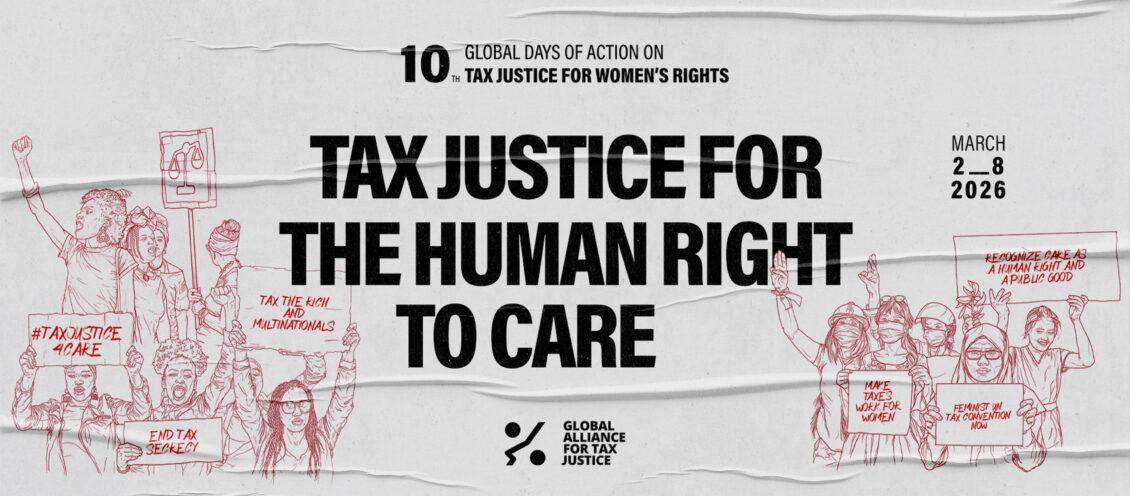
The 10th annual Global Days of Action on Tax Justice for Women’s Rights campaign takes place from March 2nd to 8th, 2026.
By: Maureen Mburu, GATJ Tax and Gender Lead & Africa Campaigns Coordinator
This year marks the momentous 10th anniversary of the Global Days of Action on Tax Justice for Women’s Rights (GDOA). For a decade, the tax justice and feminist movements have come together to make taxes work for women. The 2026 campaign takes place during a historic moment, with the negotiations for the new legally-binding global tax rules, the UN Framework Convention on International Tax Cooperation (UN Tax Convention), well underway.
From March 2nd to March 8th, 2026, feminists, tax justice advocates, and trade unionists rally under the banner of Tax Justice for the Human Right to Care, demanding fiscal reforms at the national and international level that ensure States can protect, respect, and fulfill the human right to care by adequately financing quality public services that advance gender equality and reduce the burden of unpaid care work on women, girls, and gender-diverse people.
What is care?
Care is the foundation of our lives and our economies with every person requiring care at some point in their life. Care work, whether paid or unpaid, encompasses the labor related to childcare, eldercare, healthcare, and social support roles that are predominantly carried out by women. Human existence, and the functioning of society at large, depend on care, which is mostly provided by women’s unpaid labor. According to the ILO, women spend on average 3.2 times more hours on unpaid care work than men. In addition, ILO data further indicates that unpaid care work equals about 9% of global GDP, or appx US$11 trillion, if only valued at minimum wage levels.
Our societies, communities, and economies are literally built on the backs of women’s unrecognized, undervalued, and unremunerated labor. The burden of unremunerated care work is a key driver of gender inequality around the world, robbing women of the time, space, and formal protections in order to develop their own life’s project.
Care as a human right
All humans have the right to care, to be cared for, and to self-care. Care is a universal need and is a necessary precondition for the full enjoyment of a dignified life. The right to care is deeply interrelated with other human rights as well, such as the right to health, the right to social security, the right to education, the right to equality and non-discrimination, and the right to work. The Inter-American Court of Human Rights recognized care as an autonomous human right in its Advisory Opinion No. 31/2025 and laid out the State’s obligations in regards to the human right to care, which include:
- Refraining from violating the right to care
- Structuring the State in a way that legally ensures the free and full exercise of the right to care
- Adopting or abolishing any laws necessary to guarantee the right to care
This means that States must take measures to progressively fulfill the right to care, including providing the means and resources necessary to effectively achieve the right to care. Realising care as a human right requires action across the 5 Rs: recognising the value of care work, reducing the unequal unpaid care burden on women through quality public services and infrastructure, redistributing care responsibilities more fairly across society and between genders, rewarding and representing care workers with decent wages, rights, and social protection. Recognising care as a human right means reclaiming the public nature of care. Care systems cannot be fixed through unpaid labour or market solutions—they require strong public investment and well-funded public services.
What does tax have to do with care?
For decades, international tax rules have perpetuated structural inequalities by shifting money from Global South countries to Global North financial centers. Multinational corporations and wealthy individuals take advantage of financial secrecy and profit shifting in order to underpay — or in some cases not pay — taxes. This leads to revenue losses. As a result, States lack adequate revenue to fund basic public services such as education and healthcare, that are fundamental to the fulfillment of human rights. Governments often attempt to make up for the lack of revenue by imposing regressive taxes, like consumption taxes, that are easy to administer but impose a greater burden on those least able to pay, disproportionately women. As the State underfunds and cuts public services due to these revenue gaps, women pick up the slack by replacing these services with their unpaid labor.
How to fulfill the human right to care?
To provide quality care systems and fulfill their obligations in relation to the human right to care, States require a large amount of income that is stable and steady over a long period of time. Tax revenue is the most stable source of income and is the only solidarity-based way to finance goods and services.
At the national level, States can establish progressive tax regimes that ensure taxpayers are taxed based on their ability to pay and refrain from placing a disproportionate tax burden on the most marginalised. National governments can establish integrated care systems that provide quality public services that are adequately financed and designed to impact the most marginalised.
However, international tax cooperation is required to achieve progress. The current international financial architecture enables multinational corporations (MNCs) and high net-worth individuals (HNWIs) to evade their responsibilities to pay their fair share in taxes. And, while high-income countries lose more in absolute dollar amounts, lower-income countries, largely in the Global South, lose a much greater proportion of their tax revenues. The present global tax rules denies Global South countries their taxing rights and deprives them of the revenues so desperately needed for public investments in care infrastructure. Governments must ensure the negotiations around the UN Tax Convention result in a robust convention, one with gender equality integrated in the provisions, that is capable of reforming the global tax rules to redistribute taxing rights and end harmful tax practices.
Framing Feminist Taxation Guide Volume 3
The Global Days of Action will also feature the launch of the highly-anticipated 3rd volume of the Framing Feminist Taxation Guide. This edition lays out what tax systems, care policy, and care financing look like around the world by providing case studies from Argentina, Ecuador, Paraguay, the Philippines, and Senegal. All of the countries examined feel the weight of structural constraints and the underfunding of care systems due to prevailing political and economic systems that place capital accumulation over human wellbeing.
Uniting to demand a feminist fiscal future
Our tax systems are not neutral. They are deeply political and reflect the values of society, and it is clear that care is undervalued. We envision an international tax system that no longer extracts value from women’s unpaid and underpaid labour, but instead redistributes resources and confirms a societal value of sustaining life, dignity, and equality.
The UN Tax Convention negotiations run from now until mid-2027 and represent a once-in-a-century opportunity to reform global tax rules in order to finance the feminist future we envision. By centering care as a human right, we can ensure that the legally-binding Convention is not merely a technical exercise but a political choice to finally ensure that governments value the lives, labour, and futures of all equally.
This year’s campaign highlights a simple truth: there is no gender equality without strong public care systems, and there are no strong public care systems without fair and progressive taxation. From 2nd to 8th March 2026, feminists, tax justice advocates, and trade unions are standing together to demand governments and policymakers:
- Recognise Care as a Human Right and a Public Good
- Fairly Allocate Taxing Rights to Advance Global and Gender Justice
- Publicly Finance Care Through Progressive and Redistributive Taxation
- Tax the Rich and Multinational Corporations
- Deliver A Feminist UN Tax Convention
- End Tax Secrecy
Take part in the campaign as we stand together to demand: tax justice for the human right to care!
- Take part in the events and see the full programme here.
- To receive the campaign toolkit, send an email to [email protected].