
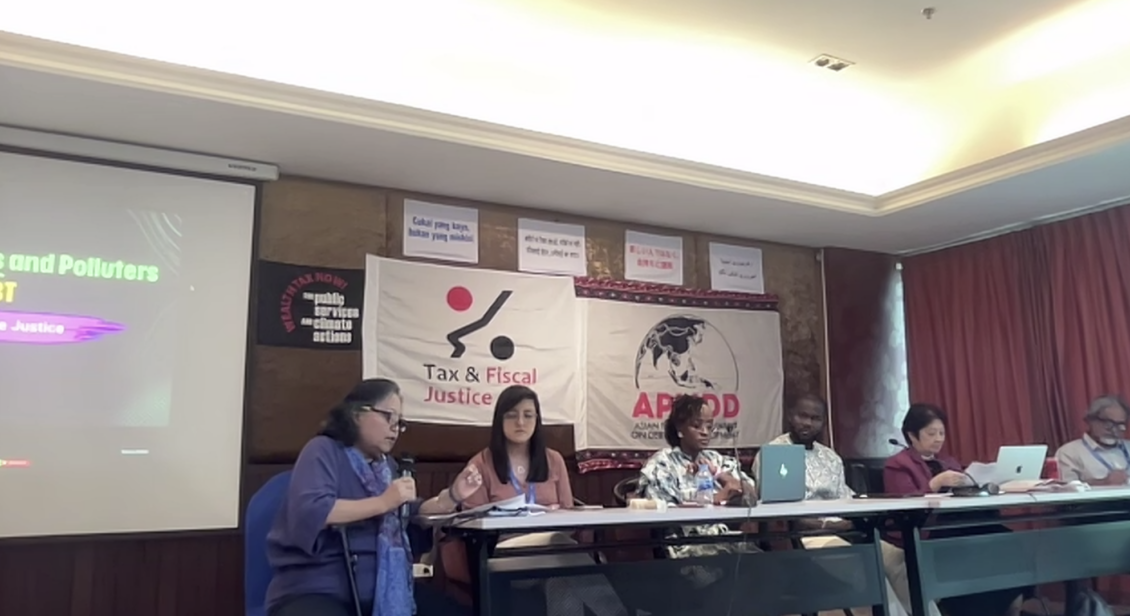
Civil society perspectives at a side-event of the IMB-WB Annual Meetings
As climate disasters intensify across the world, Global South peoples face a compounding crisis: severe fiscal distress driven by unsustainable debt burdens and inadequate public finance due to tax abuse by corporations and the super-rich. At the same time, climate reparations are needed to address loss and damage, adaptation and resilience, and mitigation and the just transition.
“Tax and debt policies are not only about finance flows: they shape development, investment, and broader relations of power,” Opened Lidy Nacpil from the Asian Peoples’ Movement on Debt and Development (APMDD) at a side-event on the sidelines of the IMF-World Bank Annual Meetings. The side event took place in Bangkok as civil society gathered for Bangkok Climate Week and the IMF and WB Annual meetings.
Cancel the Debt
During the side event, speakers called for debt cancellation and ending tax abuse by elites and multinational corporations as two concrete steps needed to stop the bleeding of public finance from the Global South and provide the fiscal space to fund urgently needed climate action.
“There is a need to invest in climate adaptation, public services, and a just energy transition but the debt crisis restricts the fiscal space. Our countries are spending more in debt repayments than in social protection and climate action,” shared Daniela Berdeja from Latindadd.
Unfair debt burdens and regressive tax policies have real impacts on the everyday lives of people. Joe Athialy from the Centre for Financial Accountability shared, “The level of inequalities that we see today are not an accident: they are a policy choice resulting from austerity policies endorsed by the IMF and World Bank.”
Tax Billionaires and Polluters
On tax, speakers continued to show the impacts of current policies. Maureen Mburu from the Global Alliance for Tax Justice (GATJ), shared, “Taxation is often presented as a technical exercise in revenue mobilisation and macroeconomic stability. But taxation is fundamentally political, with gendered impacts. It determines who contributes, who benefits from public resources, whose needs are prioritised and what services governments can provide.”
Tax abuse and regressive tax policies shifts the tax burden towards ordinary people, rather than those with the ability to pay. Often, this prevents countries from having the funds needed for quality public services. Progressive global tax rules, Mburu said, are needed to fund social protection, public services, and care.
The ongoing negotiations for a UN Framework Convention on International Tax Cooperation (UN Tax Convention) present a historic opportunity to reshape the deeply flawed international tax architecture that has disadvantaged developing countries, enabled the hoarding of untaxed wealth and profit by corporations and billionaires, and facilitated a transfer of wealth from the Global South to the Global North.
The comprehensive tax reforms include the mandate to address global tax abuse and contribute to realizing sustainable development. The global tax treaty is set to ensure a fair allocation of taxing rights across countries, the equitable taxation of multi-national enterprises, and the fair and effective taxation of the super rich. The UN tax Convention has the potential to be a powerful tool in generating the public resources, for countries in both the Global North and South.
The speakers highlighted the opportunity of the UN Tax Convention to support progressive taxation, taxing the super rich and polluters. Gerance Mutwol from Greenpeace Africa highlighted the urgency of taxing the super-rich and rectifying climate debt of the world’s richest individuals. Meliana Lumbantoruan from Public What You Pay Indonesia emphasised the role of tax in climate action, calling for a tax on fossil fuel profits under the UN Tax Convention.
Delivering Economic and Climate Justice
Throughout the side event, speakers called upon their governments and international institutions to cancel the debt and support an ambitious UN Tax Convention that meets the scale of the crisis. As shown throughout the event: there is no climate justice without debt and tax justice. The reform of the global financial architecture is urgently needed to stop loopholes that drain money from countries and to finally ensure adequate funding for social protection and public services.