
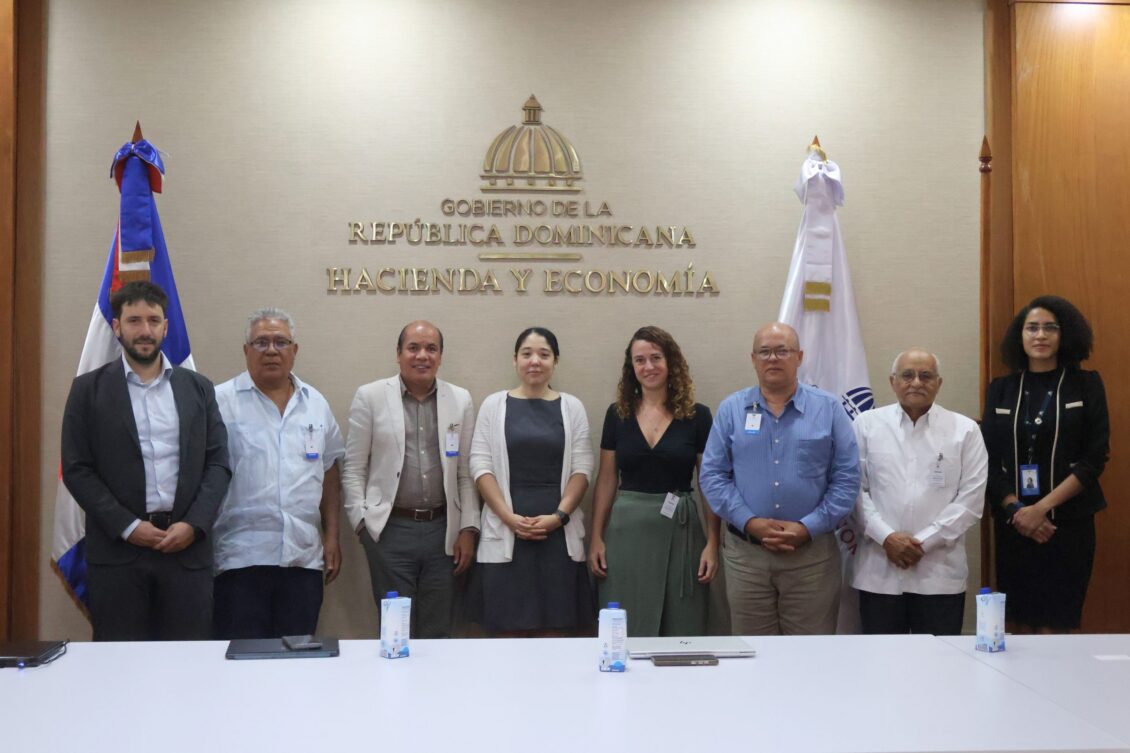
An international delegation advancing tax justice and supporting the UN Tax Convention during multi-stakeholder tour in Santo Domingo
Published by Latindadd here.
Santo Domingo, May 15, 2026 – Tax evasion and avoidance by companies in the Dominican Republic is 62.3%, drastically reducing the State’s capacity to finance public policies and address social problems such as poverty, which affects 18.9% of the population. This was one of the main concerns raised during the multi-stakeholder tour led by the Latin American and Caribbean Network for Economic, Social and Climate Justice (Latindadd), together with the Red de Justicia Fiscal de América Latina y el Caribe (RJFALC), the Global Alliance for Tax Justice (GATJ), and the Montalvo Center.
On May 14th and 15th, the delegation spoke with government authorities, legislators, civil society organizations and media, with the aim of promoting fairer, more transparent tax systems that are oriented towards guaranteeing human rights.
The visit is part of the Multi-stakeholder Tours that Latindadd and RJFALC are undertaking in 2026 to strengthen the regional tax justice agenda and promote political support for the United Nations Framework Convention on International Tax Cooperation.
A regressive tax system with low tax collection
During the meetings and discussions, local specialists and international representatives expressed concern about the Dominican Republic’s fiscal situation. Currently, the country has a tax burden of only 14.7% of GDP, placing it among the lowest levels in Latin America.
Furthermore, the tax system remains markedly regressive. While indirect taxes—which tax consumption and disproportionately affect lower-income sectors—represent 8.7% of GDP, direct taxes on income and property reach only 5.8%.
Latindadd warned that this structure limits the State’s ability to finance public services, reduce inequalities, and guarantee social rights.

Meetings with officials
The agenda included meetings with several Dominican government institutions. The delegation met with Rafael Toribio, president of the Economic and Social Council (CES), and Ana Selma, the institution’s secretary general. During the discussion, the need to resume negotiations on the Fiscal Pact, which has been pending since 2012, was emphasized.
The delegation also visited the General Directorate of Budget (DIGEPRES), where they discussed the institution’s strategic role in formulating public revenue, expenditure, and financing policies. They also highlighted the importance of initiatives such as Open Budget to strengthen transparency and citizen oversight of public spending.
Another meeting was held with the Social Control Department of the Chamber of Accounts of the Dominican Republic, where citizen control mechanisms and oversight of state spending were discussed.
The delegation also spoke with Camila Hernández, Vice Minister of Fiscal Policy at the Ministry of Finance and Economy, about the importance of the Dominican Republic supporting international processes such as the UN Framework Convention on International Tax Cooperation.

Workshop on tax justice and international taxation
As part of the tour, on May 15, the “Workshop on Fiscal Justice and International Taxation” was held at the Ebert Foundation office, with the participation of social organizations, specialists and representatives of the international delegation.
The first session, entitled “The fiscal situation of the Dominican Republic: problems, trends and perspectives”, was led by economist Apolinar Veloz, who analyzed the structural challenges of public finances and their impacts on democracy and social rights.
Subsequently, Jorge Coronado, representative of RJFALC and Latindadd, presented the Regional Agenda for Fiscal Justice and highlighted the need to move towards more progressive tax systems in Latin America and the Caribbean.
Tomás Lukin, Campaigns and Policy Advocacy Coordinator at the Global Alliance for Tax Justice, addressed the international dimension of taxation and emphasized the relevance of initiatives such as the Latin American and Caribbean Tax Platform (PTLAC), the Seville Commitment, and the UN Framework Convention on International Tax Cooperation.
The meeting concluded with a collective working session in which the participating organizations defined strategies for coordination and citizen oversight of fiscal policies.
The organizations agreed that the Dominican Republic needs to move towards a fairer, more transparent and progressive tax system, capable of reducing the burden on the most vulnerable sectors, combating corporate tax evasion and strengthening public investment for more inclusive development.
