
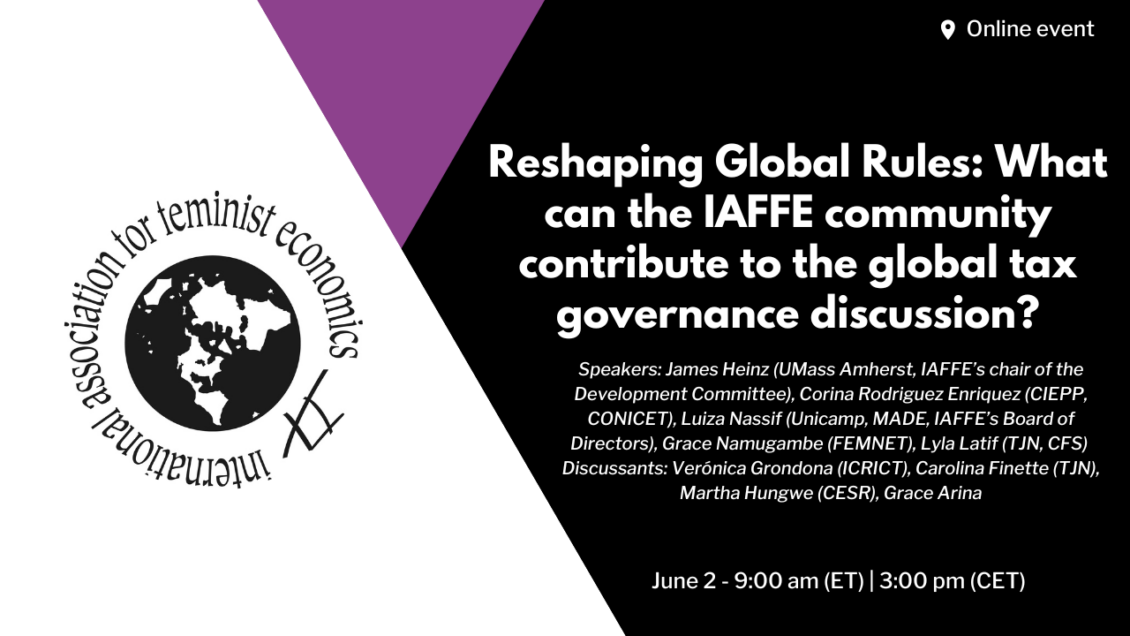
Ahead of the 2026 International Association for Feminist Economics (IAFFE), a group of feminist economists, academics, and tax justice advocates came together to discuss reshaping global rules. Co-organized by IAFFE, GATJ, ICRICT, FES, TJN, WEDO, GI-CESR, MenaFem, CESR, and AAI, the conversation highlighted the transformative potential of the global tax rules to advance gender equality and support an economy that sustains life.
Tax rules shape who has access to resources, who bears the crisis, and who has power in economic decision-making, opened Shereen Talaat (MENAFem). She reminded participants that while tax systems have worsened inequality, they are a political choice and as such can be changed to become a tool of redistribution, accountability, and social justice.
The present global tax system is a continuation of colonial rule, decided by a small group of rich countries at the OECD and continuing the cycle of extraction leading to a flow of resources from the Global South to the Global South, reflected Corina Rodriguez (CONICET and CIEPP) on the history of the global rules.
Luiza Nassif (University of Campinas) expanded on the issue, sharing that these OECD-led rules have long enabled accumulation of wealth for the richest through profit-shifting by corporations, tax evasion by the ultra-wealthy, and illicit financial flows. This robs governments, especially in the Global South, of public revenue and deepening gender inequalities through the inability to deliver quality services from education to healthcare.
In a historic move led by the Africa Group, countries are now negotiating a United Nations Framework Convention on International Tax Cooperation (UN Tax Convention) from now until mid-2027. This process represents a historic opportunity to create fair and effective global tax rules through establishing legally-binding commitments on a wide range of tax issues from a fair allocation of taxing rights to curbing harmful tax practices. Katie Tobin (WEDO) shared that these negotiations have the potential to change the rules of the game for countries to reclaim tax sovereignty and the fiscal space to fund public services.
In the negotiations, civil society has clear demands. Grace Namugambe (FEMNET) highlighted the joint positions by civil society, emphasizing how each area of the negotiations has the potential to increase gender equality.
Care was a key topic of the discussion. Care is at the heart of our societies and an essential contribution to the global economy, yet the unpaid labor carried out primarily by women and girls is made invisible in the current tax system, shared James Heintz (IAFFE). Dr. Lyla Latif (TJN) connected the structural issue of unpaid care work to unpaid data: the fiscal system is built around the productive economy which excludes the unpaid carer and unpaid data subject that the national accounts refuse the records and the tax base refuses to reach. Latif highlighted the transformational potential of the negotiations to address this.
Feminist economics show how international taxation is about the role and responsibility of the State as well as the capacity of the State to fulfil these responsibilities and be a tool for human rights. Now, feminists, academics, and tax justice advocates will continue this collaboration at the upcoming IAFFE conference in July and at the 5th session of UN Tax Convention negotiations in August.